Every year, around the same time, parents across India do the same thing. They pull out last year's school bag, stare at the broken zipper, the fraying strap, and the mysterious stain from sometime in October, and they decide it needs to go.
Then comes the search. Which bag? What size? How heavy? What will actually hold up?
This guide cuts through all of it. Age-by-age recommendations, what to check before buying, and what is worth spending money on. Whether you are buying for a 5-year-old starting school for the first time or a 12-year-old who has opinions about everything, including their bag, this is where you start.
Why the School Bag Deserves More Thought Than It Gets
Most school bag decisions happen fast. They get made based on what looks good in a photo, what is on sale, or what another parent recommended at the school gate. The child carries it five days a week for ten months. The decision takes about six minutes.
The consequences of a bad one show up slowly. Shoulder pain. The child is slumping forward while walking. The habit of dragging the bag instead of wearing it is because the fit is wrong.
The standard recommendation is that a packed school bag should not exceed 10% of a child's body weight. For a 25 kg child, that is a maximum of 2.5 kg. Most school bags in India, once loaded with books and a water bottle, cross this by at least a kilogram. Often more.
The bag itself is part of that calculation. A dense bag with thick material and heavy hardware adds dead weight before a single book goes in. Lightweight bags are not flimsy bags. They are the smarter ones.

Age-by-Age: What Kind of Bag Actually Works
Pre-Primary and Kindergarten (3 to 5 Years)
Kids at this age carry almost nothing. A small notebook, a colouring book, a snack box, and a water bottle. That is genuinely the full list.
The bag should be small. Not because it looks cute on a tiny child, but because an oversized bag sits at the wrong point on a 4-year-old's back entirely, making it uncomfortable and hard to manage by the time they reach the classroom.
What works for this age group:
-
Bags up to 14 inches in height
-
Very wide, padded shoulder straps that sit high on the back
-
Fun prints or characters the child responds to
-
Simple zip with a single main compartment
That last point about design is not a small thing. Getting a pre-primary child to cooperate with wearing their bag every single morning is its own project. A bag they chose because they love what is in it is a bag they put on without an argument. Worth it.
School pouches alongside the bag are also useful here. Young children need snacks and small items accessible without digging through the main compartment.
Primary School (6 to 9 Years)
The load jumps considerably from Class 1 onwards. Multiple textbooks, a full notebook set, a pencil case, a lunch box, and a water bottle. The bag has actual work to do now, and the straps and back panel start to matter a lot more.
What this age group needs:
-
A 16-inch bag handles this load comfortably without being too large for the frame
-
Two main compartments: one for books, one for food and bottles
-
A padded back panel, not just padded straps
-
A mesh side pocket for the water bottle (reaching into the main compartment at lunch is a design failure)
Backpacks for school work well through most of primary school. Some parents switch to trolley bags from Class 2 onwards when the textbook count gets genuinely heavy. The trade-off is stairs. Most Indian school buildings were not designed with trolley bags in mind.
Upper Primary and Middle School (10 to 13 Years)
This age group has opinions. Strong ones. About colour, about design, about whether the bag is something they would actually want to be seen with at school.
This is not vanity. It is a social reality. A bag a child refuses to wear because they find it embarrassing is worse than no bag at all. Factor this in.
What works here:
-
18-inch bags for the full Class 5 and above book load
-
A dedicated sleeve or pocket for a tablet or Chromebook, which many Indian schools now require
-
Solid zipper construction, because this age group is not careful with their bags
-
Neutral or design-forward options, depending on the child
Ergonomics matter most at this stage because the load is at its heaviest and the child is carrying it for the longest stretches, including after school activities.

What to Actually Check Before You Buy
This is where buying decisions tend to fall apart. People look at the photo and the price. These are the things that matter more.
Strap quality: Pick the bag up by the shoulder straps and shake it gently. If the attachment points flex or creak, the stitching will not last. Wide, padded straps that attach properly at both the top and bottom of the bag are what you want.
The back panel: Press the back of the bag flat. A bag with no structure here will press directly into the spine once it is loaded. A foam or air-mesh panel keeps the bag slightly away from the back, which also reduces sweating, which matters in Indian summers.
Empty weight: Pick it up before anything goes in. If it already feels heavy, it will be a genuine problem by February.
Zipper quality: Pull at the zipper teeth. Run it back and forth a few times. A zipper that catches on an empty bag will be a disaster when the bag is full. School bags get opened and closed hundreds of times throughout the year. A bad zipper is not a minor inconvenience.
Compartment layout: Books should sit in the back compartment closest to the spine. Food and bottles should be in a separate section. If the layout forces mixing, the bag will be disorganised within a week, and the child will never bother keeping it otherwise.
Finding the Right School Bags for Kids in India 2026
The range of kids' school bags available in India has grown considerably, and the quality has improved with it. More brands are now building bags that combine real structure with designs children actually want to carry. The days of choosing between a good-looking bag and a functional one are mostly over.
A few things to watch when buying kids' bags online:
Always check the actual centimetre dimensions, not just the inch label. A product image can make a bag look proportionally right without giving any real sense of size. Confirm the measurements against your child's torso length before ordering.
Also, look for the empty bag weight in the product specs. If it is not listed, ask before buying. That single number tells you more than most descriptions do.
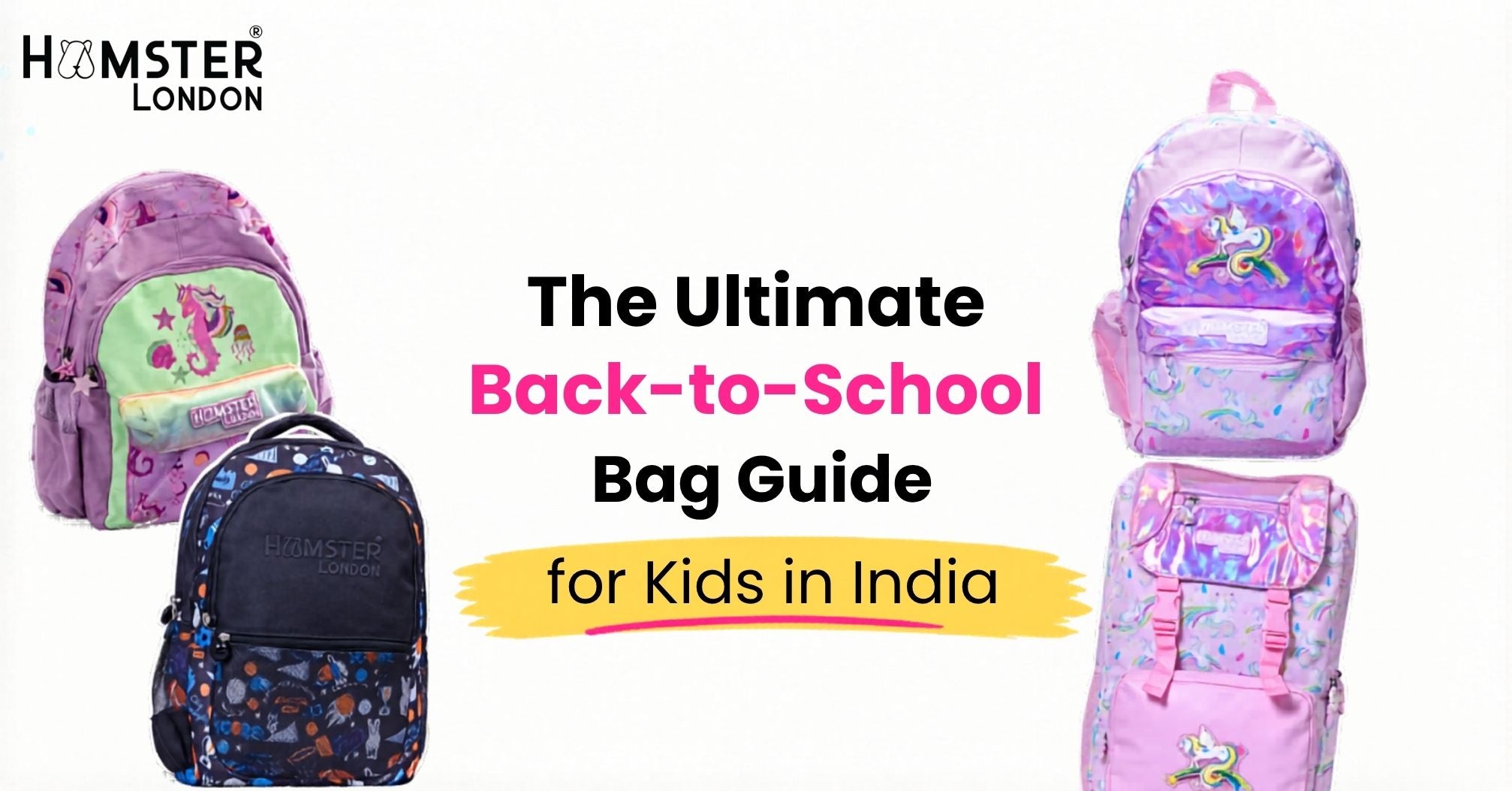
Back to School 2026: Picks from Hamster London's Kids Range
Hamster London bags in the Back to School 2026 collection are built around the problems this guide covers: correct sizing for different ages, lightweight construction, and designs children are willing to carry without a fight.
For pre-primary and early primary kids:
The School Bundle with Twinkle Horn Backpack, Sling, Pouch, and Sipper and the Royal London Bundle give you everything in one set at Rs. 5,499. For parents who do not want to hunt separately for a matching pouch and water bottle, this is the straightforward answer. Good design, age-appropriate sizing, and one decision instead of four.
For primary school kids (6 to 10 years):
The Insider Backpack in 16 inches is sized right for this age group. Available in pink and blue, with padded straps, two compartments, and a front pocket. At Rs. 3,290, it is a kids backpack India parents keep coming back to because it holds up through a full school year.
The Essential Backpack with Bag Charm is the same size with a charm attachment point. For kids who want their bag to feel specifically like theirs and no one else's, this is the one.
For upper primary kids:
The Insider Jumbo Backpack at 18 inches handles the heavier load without looking oversized. Padded back panel, proper strap construction, available in pink and blue at Rs. 4,490. It is designed for the age where the load is real, and the bag needs to keep up.
For genuinely heavy load days, the Insider Trolley Bag rolls when needed, stands upright on its own, and takes the pressure off the spine entirely.
Three Things Worth Doing Before Day One
Load the bag the night before and weigh it: Do this at the start of the term and keep the habit going. If it crosses 10% of your child's body weight, something comes out. Not something smaller. Something gone.
Set up the sections properly: Books in the back compartment, pencil case in the front pocket, bottle in the mesh side pocket. Show the child once. Most kids are better at maintaining this than parents expect, once it is set up for them clearly.
Label everything: The bag, the pouch, the bottle, the lunch box. Every single item. Before day one, not after the first disappearance.
FAQs
What size school bag is right for a 7-year-old?
A 16-inch backpack works well for most 7-year-olds in Indian primary schools. It fits standard textbooks and notebooks without the bag sitting below the hips, which is the sign that a bag is too large for the child's frame. The packed weight should stay under 3 kg. If you are unsure, measure the child's torso from shoulder to hip and compare it to the bag's back panel length before buying.
What is the best school bag for children with heavy bookloads?
Look for a bag with a proper padded back panel (not just padded straps), wide shoulder straps, and at least two separately organised compartments. Bags in the 16 to 18 inch range with mesh or foam back panels distribute weight better than flat-back designs. For children carrying textbooks for five or more subjects every day, a trolley bag is worth seriously considering, provided the school layout supports it.
Are trolley bags better than backpacks for school in India?
Trolley bags take the load off the spine and shoulders, which is a real advantage for heavy school schedules. They work well where the flooring is smooth, and stairs are minimal. The practical problem is that many Indian school buildings are not trolley-friendly. Many families use a backpack on lighter days and a trolley on heavy ones. It depends on the school and the weekly timetable.
What should I check when buying kids bags online?
Check the dimensions in centimetres, not just the inch label. Look for the empty bag weight in the product specs. Read reviews specifically about zipper durability and how the straps hold up after three months of daily use. A bag that looks great in photos but has weak zippers will need replacing well before the school year ends.
How do I know if my child's school bag is too heavy?
The packed bag should not exceed 10% of the child's body weight. Beyond the number, watch for the child leaning noticeably forward while wearing the bag, rounded shoulders after school, or any mention of back and shoulder pain during the term. These are the signs that either the load needs reducing, or the bag fit needs correcting.
Final Thought
The school bag gets chosen in about six minutes and is carried for 200 school days.
A bag that fits properly, weighs very little on its own, and separates books from food and bottles makes mornings easier and protects posture across the whole year. A bad one gets noticed by November.
Get the size right for the age. Check the back panel before anything else. Let the child have a say in the design, because a bag they like is one they will actually wear properly. And buy from a brand that builds for real school conditions, not just the product photo.
Hamster London's kids bags are built for all of this, with the right size at every age and designs that last the full school year.
Shop the Back to School 2026 collection at Hamster London.